
Introduction: The Wake-Up Call That Started It All
I’ll never forget the phone call from Sarah, one of my most dedicated students. She had spent eight months mastering Arabic Dialects Modern Standard Arabic (MSA)—her grammar was impeccable, her vocabulary extensive. Yet, within 24 hours of landing in Cairo for her dream job, she called me, her voice thick with frustration.
“Nobody speaks like my textbook,” she said. “When I order coffee in Fusha, they stare at me like I’m giving a speech at the UN. The taxi driver’s Arabic sounds like a completely different language.”
Sarah’s story isn’t unique. It’s the moment of truth for every Arabic learner: the realization that the formal language of books and news is not the language of the street, the home, or the heart.
In 2026, the Arab world is more connected than ever, yet its linguistic soul remains vibrantly diverse. Arabic dialects (Ammiya) are not just accents; they are living, breathing languages that carry the history, humor, and identity of over 400 million people. They are the key to:
- Real Conversations: Moving beyond textbook phrases to genuine interaction.
- Career Advancement: Building trust and rapport in business hubs from Dubai to Riyadh.
- Cultural Belonging: Understanding the jokes, music, and social nuances that define daily life.
This guide is your comprehensive roadmap. Whether you’re a traveler, professional, heritage learner, or culture enthusiast, we will demystify the dialect landscape, help you choose your linguistic path, and provide the tools to walk it with confidence. Forget the confusion—your journey to authentic Arabic starts here.
The Big Picture: MSA vs. Dialects – Why You Need Both
Before exploring specific dialects, you must understand the core reality of the Arab world: Diglossia. This is the simultaneous use of two distinct varieties of the same language.
| Aspect | Modern Standard Arabic (MSA / الفصحى) | Colloquial Dialects (العامية) |
|---|---|---|
| Primary Use | Writing, formal media, academic texts, official speeches. | Daily conversation, social media, music, films, family talk. |
| How it Sounds | Formal, grammatically complex, uniform across regions. | Relaxed, simplified grammar, rich with regional flavor. |
| Your Goal | To read the news, understand formal content, write professionally. | To speak with friends, connect with locals, live the culture. |
Think of it this way: MSA is the elegant suit you wear to a job interview. Your chosen dialect is the comfortable, stylish outfit you wear to meet friends for coffee. You need both for a complete wardrobe.
The Critical Mistake & The Solution:
The mistake is choosing only one. The solution is Dual Proficiency.
- Start with the Alphabet & MSA Basics: Spend the first 2-3 months building your foundation. Learn the script and basic MSA sentence structure.
- Integrate Your Target Dialect Early: By month 3, begin layering your chosen dialect onto this foundation. Use MSA as your “root system” for reading and the dialect as the “branches” for speaking.
- The 60/40 Rule: Dedicate 60% of your study time to your dialect (for immediate conversational ability) and 40% to MSA (for literacy and formal comprehension).
The Major Dialect Families: A Regional Breakdown
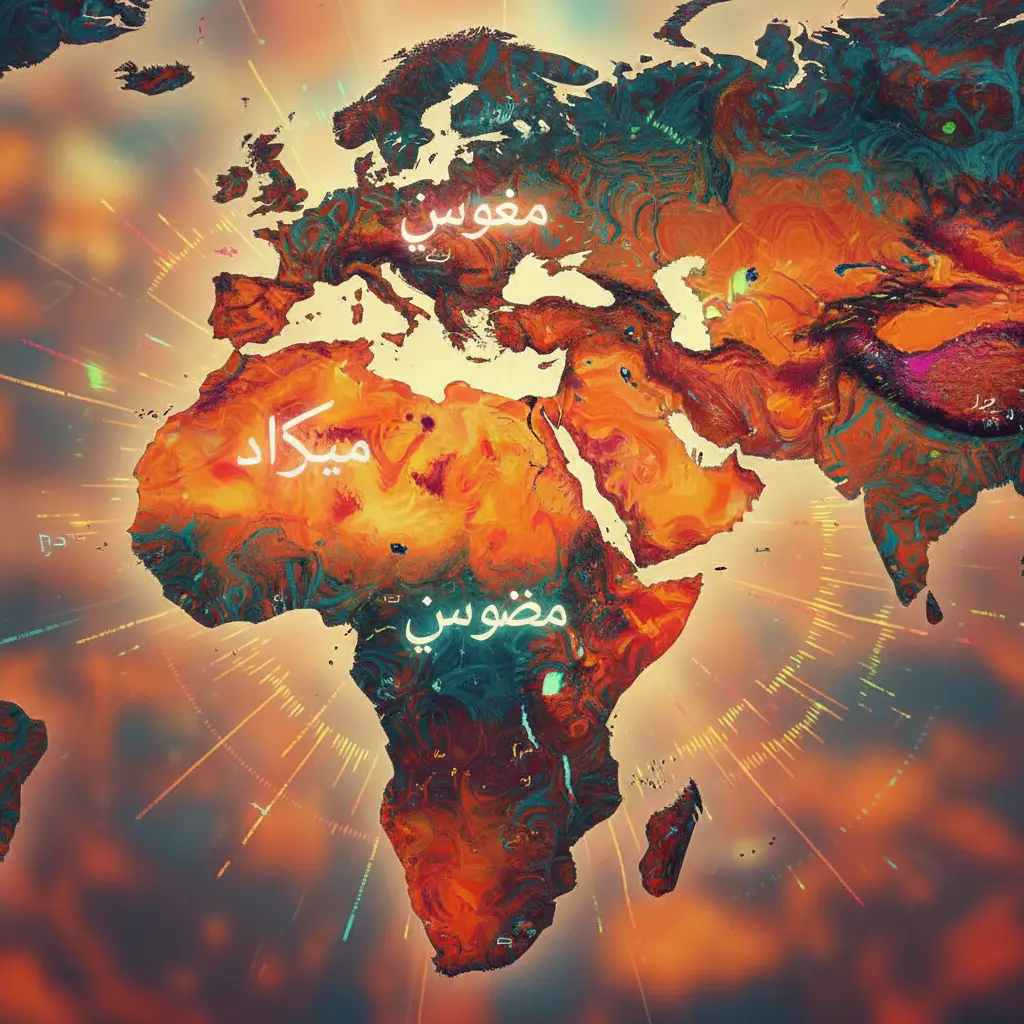
While there are dozens of local varieties, Arabic dialects cluster into five major families. Understanding these groups is your first step in navigating the linguistic map.
A. Egyptian Arabic (مصري): The Media Giant
- Where: Egypt (100+ million speakers).
- The Vibe: Confident, humorous, and direct. The “Hollywood” of the Arab world due to its century-long dominance in film and music.
- Key Features:
- Pronunciation: The ج (jeem) becomes a hard ‘G’ (جمل → gamal). The ق (qaf) becomes a glottal stop ‘ ء ‘ (قلب → ‘alb).
- Grammar: Simplified verb conjugations. Negation uses ما…ش (ما عرفش – “I don’t know”).
- High-Frequency Word: إزاي؟ (izzay?) – “How?”
- Who Should Learn It?
- Anyone wanting the most widely understood dialect across the Arab world.
- Lovers of Arab cinema, music, and pop culture.
- Travelers to Egypt.
- First-Step Resource: Dive into our focused guide: Your way to learn Egyptian Arabic online fast now.
B. Levantine Arabic (شامي): The Melodic Bridge
- Where: Jordan, Palestine, Lebanon, Syria.
- The Vibe: Polite, melodic, and business-savvy. Considered the most “musical” and is a common lingua franca in regional business.
- Key Features:
- Pronunciation: Softer than Egyptian. The ق (qaf) is often a glottal stop in urban areas. Distinctive future tense marker رح (رح أروح – “I will go”).
- Grammar: Closer to MSA structure than other dialects, making it a smooth transition for learners.
- High-Frequency Word: شو؟ (shu?) – “What?”
- Who Should Learn It?
- Professionals doing business across the Middle East.
- Learners who value a clear, moderate dialect close to MSA.
- Those drawn to the culture and history of the Levant.
- First-Step Resource: Begin with Jordanian Arabic: The 10 Tips to Learn Jordanian Arabic Online now.
C. Gulf Arabic (خليجي): The Language of Opportunity
- Where: UAE, Saudi Arabia, Qatar, Kuwait, Bahrain, Oman.
- The Vibe: Traditional yet modern, reflecting Bedouin heritage and global economic power. Essential for anyone in the GCC’s thriving business sectors.
- Key Features:
- Pronunciation: The ق (qaf) often becomes a ‘G’ sound (قهوة → gahwa). The ك (kaf) can become a ‘Ch’ (چ) in some contexts.
- Vocabulary: Rich in terms related to hospitality, trade, and desert life.
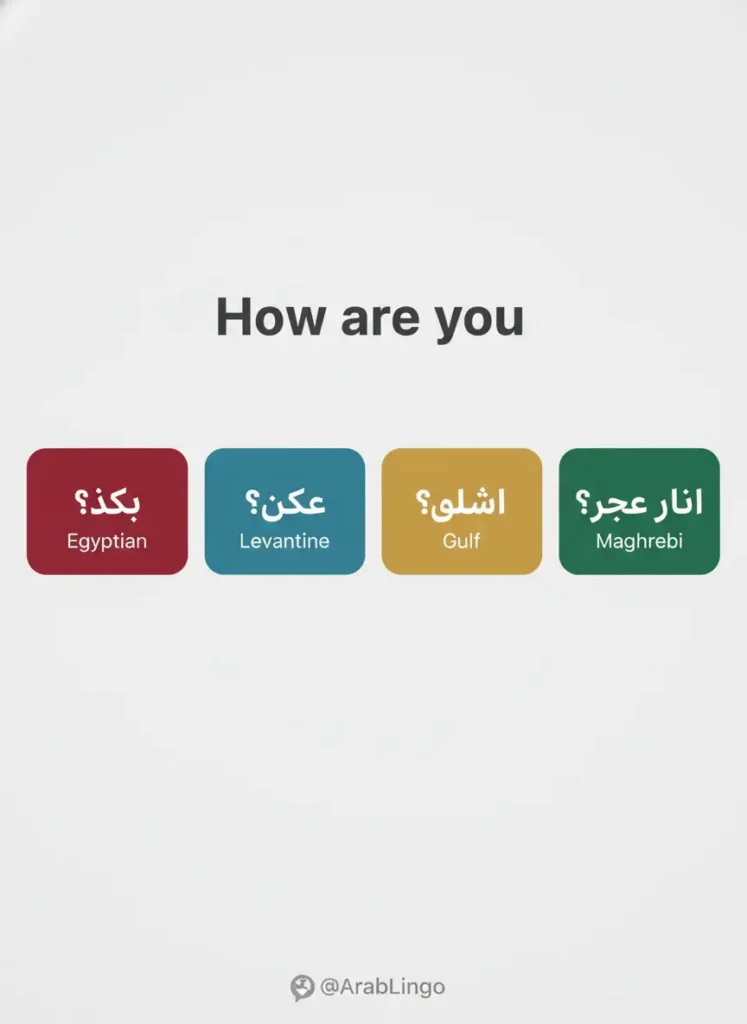
- High-Frequency Words: شلونك؟ (shlonak?) – “How are you?” | ويش؟ (wesh?) – “What?”
- Who Should Learn It?
- Professionals relocating or working in the Gulf states.
- Anyone in finance, tech, energy, or luxury tourism in the GCC.
- Expats seeking deeper social integration in the UAE, Qatar, or Saudi Arabia.
- First-Step Resources:
- For UAE focus: Your way to learn Emirati Arabic online fast now.
- For the broader region: The best 10 Ways To Learn Gulf Arabic Online.
D. Iraqi Arabic: The Poetic Soul
- Where: Iraq.
- The Vibe: Deep, poetic, and resilient. A unique dialect that acts as a bridge between Gulf and Levantine, infused with Mesopotamian history.
- Key Features:
- Pronunciation: Famous for its use of the ‘Ch’ (چ) sound. The ق (qaf) in Baghdad is often a ‘G’.
- Vocabulary: Contains loanwords from Persian, Turkish, and Aramaic, reflecting its ancient crossroads heritage.
- High-Frequency Word: شلونك؟ (shlonak?) – “How are you?” (similar to Gulf, but with a different intonation).
- Who Should Learn It?
- Those working in reconstruction, development, or diplomacy in Iraq.
- Heritage learners reconnecting with Iraqi roots.
- Anyone fascinated by the region’s deep history and rich literary tradition.
- First-Step Resource: Explore our dedicated guide: The 10 Resources to Learn Iraqi Arabic Online Fast now.
E. Maghrebi Arabic (مغربي): The Distinctive North
- Where: Morocco, Algeria, Tunisia, Libya.
- The Vibe: Fast-paced, rhythmic, and a linguistic tapestry woven from Arabic, Berber (Amazigh), and French (or Spanish) influences. The most distinct from MSA.
- Key Features:
- Pronunciation: Very fast speech with many short vowels dropped. Sounds can be quite different from Eastern Arabic.
- Vocabulary: Heavy borrowing from French (l’cuisine for kitchen) and Berber (بزاف bezzaf for “a lot”).
- High-Frequency Word: واش؟ (wash?) – “What?” (Morocco/Algeria).
- Who Should Learn It?
- Travelers or professionals focused on North Africa.
- French speakers (who will find a significant advantage).
- Adventurous learners looking for a rewarding challenge.
- First-Step Resource: Tackle the Algerian variant: Best way to learn Algerian Arabic online now.
How to Choose Your Dialect: A 5-Step Decision Framework

Choosing a dialect is a personal strategic decision. Ask yourself these questions:
Step 1: What is Your PRIMARY Goal?
- Travel & Tourism: Learn the dialect of your destination (Egyptian for Egypt, Levantine for Jordan, etc.).
- Business & Career: Gulf Arabic for the GCC. Levantine or Egyptian for pan-regional business.
- Family & Heritage: The choice is made for you! Learn your family’s dialect.
- Media & Culture: Egyptian for classic films. Levantine for modern TV series.
the full guide about Egyptian arabic
Step 2: Where Will You Use It? (Geography)
- Single Country Focus: Learn that country’s specific dialect.
- Regional/Uncertain: Choose Egyptian (most widely understood) or Levantine (business-friendly and clear).
Step 3: What Resources Are Available?
- High Resources: Egyptian, Levantine. (Easiest to find tutors, courses, media).
- Medium & Growing: Gulf Arabic.
- More Niche: Iraqi, Maghrebi. (May require more dedicated searching or immersion).
Step 4: Consider the “Transferability”
How useful will it be outside its core region?
- Egyptian (Highest transferability)
- Levantine (High, especially in business)
- Gulf (Growing due to economic influence)
- Iraqi, Maghrebi (Lower transferability, but essential for their regions)
Step 5: Be Honest About the “Challenge Factor”
- Easier Transition from MSA: Levantine, then Egyptian.
- Moderate Challenge: Gulf, Iraqi.
- Highest Challenge: Maghrebi dialects (due to speed and unique vocabulary).
Your Answer: The right dialect is the one that best aligns with your answers to these questions. Write it down: “I am learning [Dialect] because [Your Primary Goal].”
Your 2026 Learning Toolkit: Practical Strategies for Success
Once you’ve chosen your dialect, implement these modern, effective strategies.
1. Immersive Media Diet: Consume 30 minutes of native content daily.
- Egyptian: Classic films (Omar Sharif, Faten Hamama), modern series, music by Amr Diab.
- Levantine: Syrian/Lebanese dramas (Bab Al-Hara), podcasts like “Sarde After Dinner,” music by Fairuz.
- Gulf: Emirati/Saudi YouTube vloggers, “Khaliji” music playlists on Spotify.
- Iraqi: Iraqi talk shows on YouTube, traditional Maqam music.
- Maghrebi: Algerian/Moroccan Rai music, North African film festivals.
2. Master the Core 200: Every dialect has ~200 high-frequency words that make up 70% of daily conversation. Use spaced-repetition apps (Anki, Quizlet) to drill these first.
3. Shadowing Technique: Listen to a short audio clip (a sentence or two) from a native speaker. Pause. Repeat it aloud, mimicking their exact pronunciation, rhythm, and intonation. This builds muscle memory for the accent.
4. Find a Dialect-Specific Tutor: Don’t settle for a generic “Arabic” tutor. Use platforms like iTalki or Preply to find a native speaker from your target region who specializes in teaching their dialect to learners.
5. Engage in Digital Communities: Follow influencers, join Facebook groups (e.g., “Learn Egyptian Arabic”), and participate in Twitter/X conversations in your target dialect.
Avoid These 5 Common Mistakes
Mistake 1: Learning Two Dialects Simultaneously.
- The Fix: Commit to one dialect for at least your first year. Master its system before adding another.
Mistake 2: Ignoring Culture.
- The Fix: Language is a cultural vessel. Learn why شاي (tea) is central to Iraqi hospitality, or how Egyptian humor (فكاهة) works. Our guides integrate these nuances.
Mistake 3: Over-Relying on Translation Apps.
- The Fix: Apps like Google Translate are great for MSA but often miss dialectal “soul” and context. Use them for words, not for learning how to speak.
Mistake 4: Fearing “Incorrect” Pronunciation.
- The Fix: Embrace the dialect’s sounds! Pronouncing ج as a hard ‘G’ in Egyptian isn’t wrong—it’s essential. Natives appreciate the effort far more than perfect MSA.
Mistake 5: The “All or Nothing” Mindset (MSA vs. Dialect).
- The Fix: Remember the 60/40 rule. Build dual proficiency. They support each other.
Success Stories: Proof the Journey Works
Michael’s Gulf Breakthrough: An American engineer in Dubai initially learned Egyptian Arabic. While useful, it didn’t foster deep local connections. After switching to Emirati Arabic using focused resources, within 6 months he was understanding office banter and was invited to a colleague’s home—a key cultural milestone that boosted his career.
Lisa’s Field Effectiveness: An NGO worker in Jordan committed to Levantine (Jordanian) Arabic from day one. Within 5 months, she could conduct field interviews without an interpreter, building unprecedented trust with local communities and making her projects more effective.
Ahmed’s Heritage Reclaimed: A second-generation Iraqi-American used Iraqi Arabic resources to reconnect with his family’s roots. He progressed from basic phrases to understanding his grandparents’ stories and jokes, transforming his sense of identity and belonging.
Conclusion: Your First Word Awaits
The world of Arabic dialects is not a barrier—it’s a spectrum of bridges. Each bridge leads to a different courtyard of the vast Arab home, each with its own stories, laughter, and way of life.
Sarah, from our introduction, eventually found her bridge. She mastered Egyptian Arabic. Today, she runs a successful business in Cairo. But she often reflects: “I wish I had known to choose my dialect strategically from day one. It would have saved me a year of feeling lost.”
You now have that knowledge. You have the map, the framework, and the tools.
Your journey of a thousand conversations begins with a single, deliberate choice.
Choose the dialect that aligns with your goal. Immerse yourself in its sounds. Embrace its rhythm. And know that with each phrase you learn, you’re not just memorizing vocabulary—you’re earning a key to unlock authentic human connection.
Ready to Take Your First Strategic Step?
At Alphabet Arabic Academy, we specialize in turning dialect confusion into conversational confidence. Our native instructors and structured pathways are designed for your specific goals.
👉 Book your free dialect consultation today and let’s build your personalized roadmap to fluency.
Explore our specialized deep-dive guides:
- Your way to learn Emirati Arabic online fast now
- The best 10 Ways To Learn Gulf Arabic Online
- The 10 Tips to Learn Jordanian Arabic Online now
- The 10 Resources to Learn Iraqi Arabic Online Fast now
- Best way to learn Algerian Arabic online now
This comprehensive guide merges the strategic insight of a pillar article with the engaging narrative of a mega-guide, designed to be your ultimate reference for mastering Arabic dialects in 2026.